Autonomous operations
for production systems.
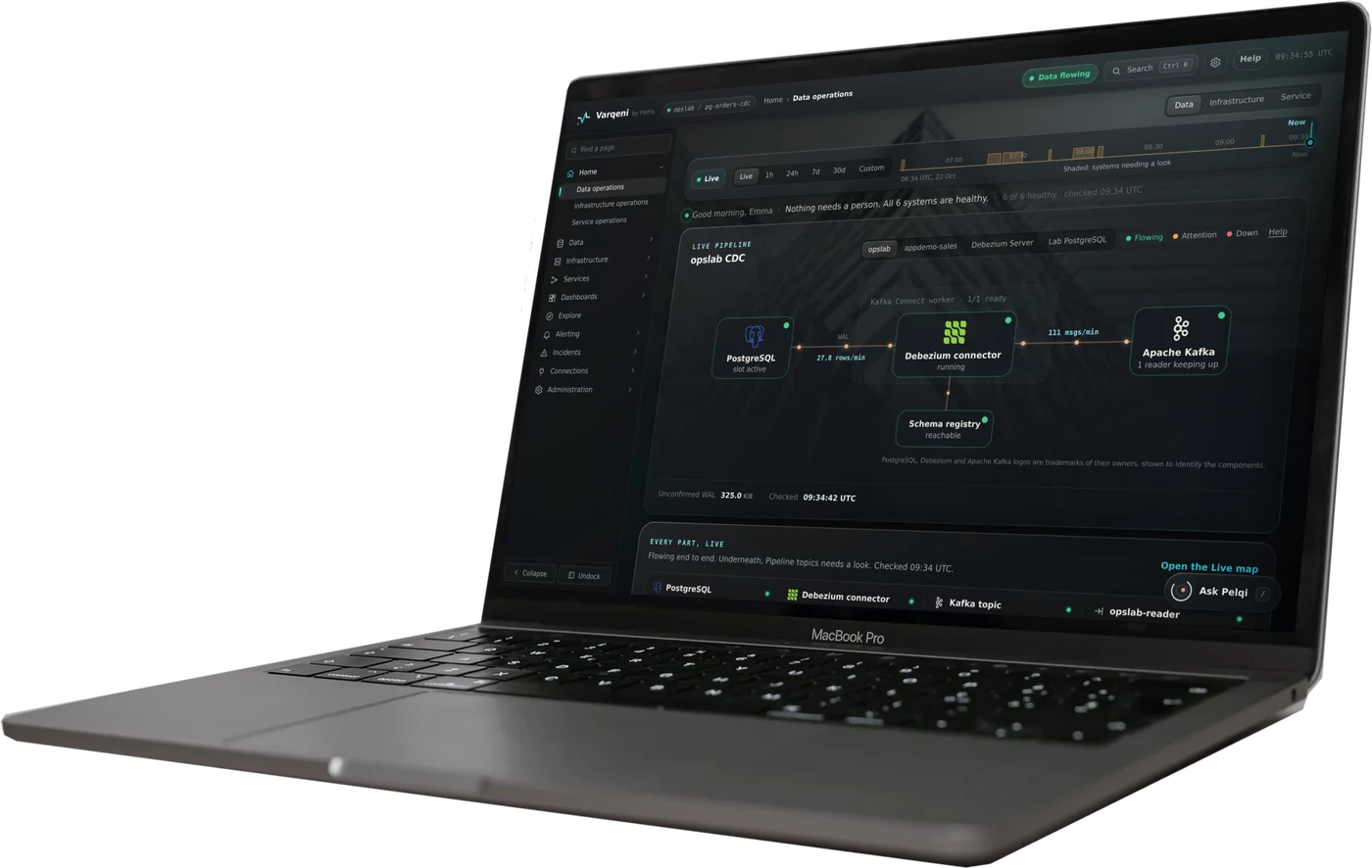
Starting with the data infrastructure your business depends on. Varqeni's agents watch your change data capture pipelines around the clock, investigate every signal and fix what you approve. Every answer cites its evidence. Every action is verified and sealed.
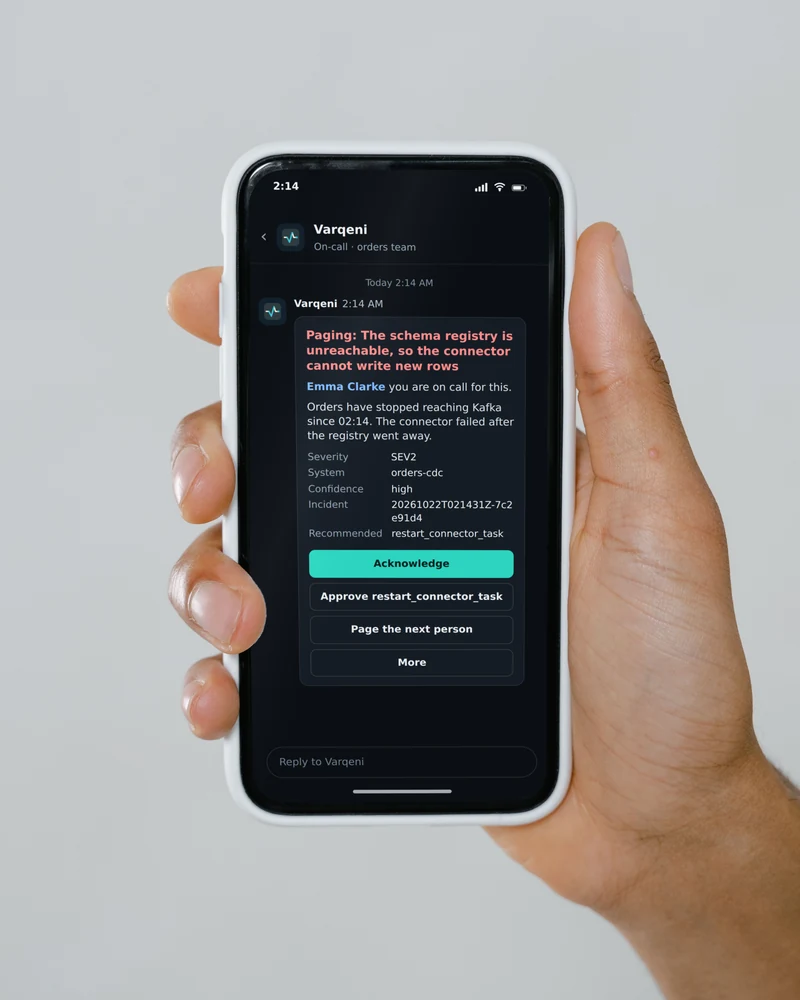
Fewer pages and fewer 2 a.m. investigations. Varqeni handles routine investigation and, within the limits you approve, the fix, and brings in a person only when judgment is needed. Starting with data platforms, with every action sealed for review.
Dashboards show you. Runbooks wait for you. Pagers wake you.
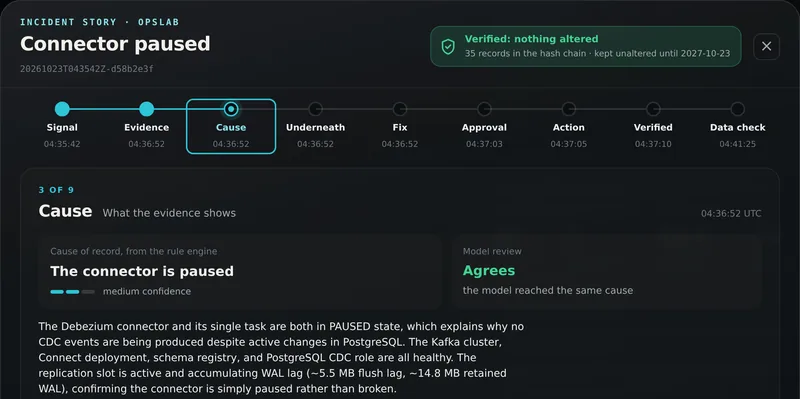
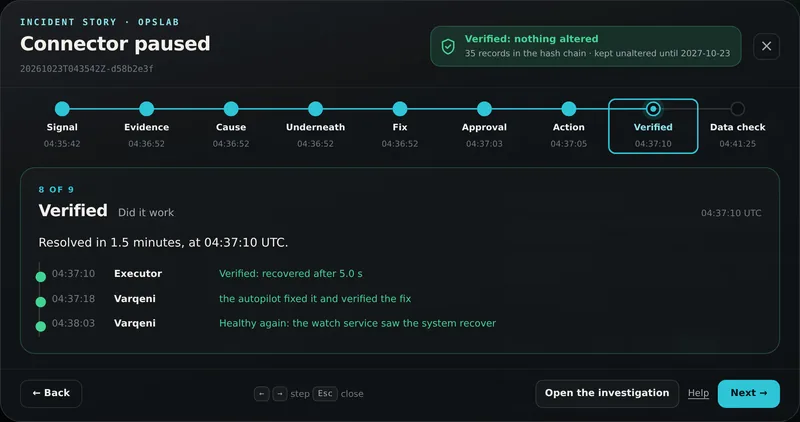
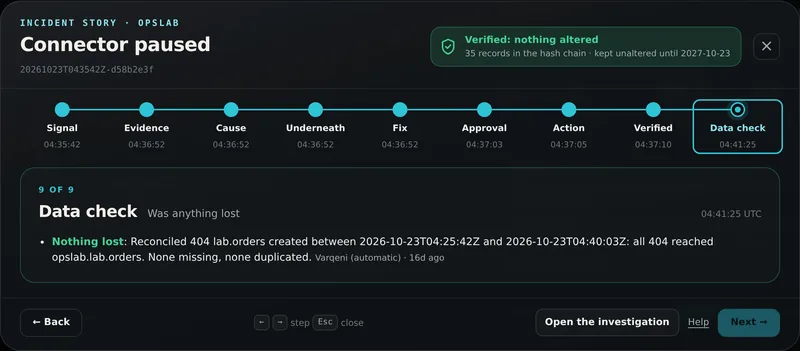
Varqeni finds the cause, runs the fix you approved and proves it worked.
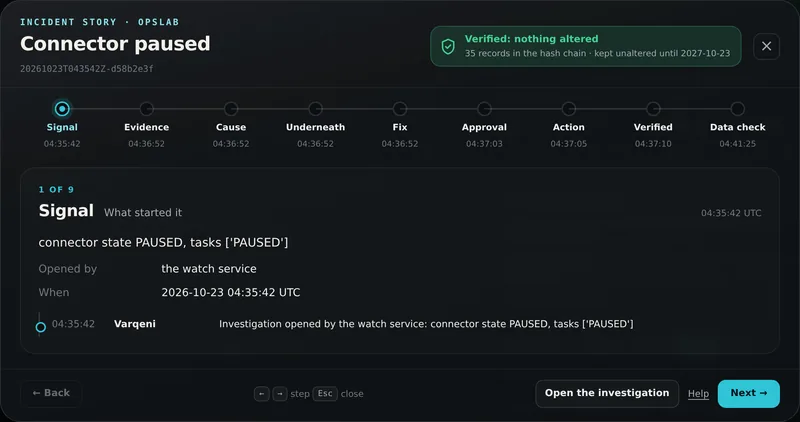
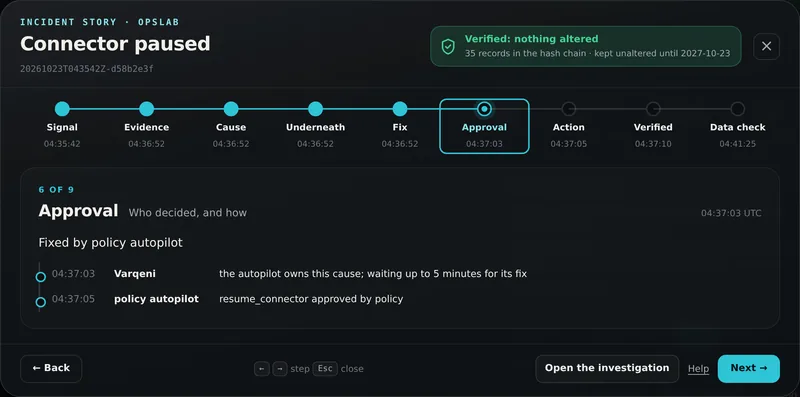
A stalled pipeline, fixed before anyone woke.
Every screen here is a real capture from the Fortis lab console, 23 October 2026.

Works with the stack you already run
 DebeziumApache Kafka
 Apicurio RegistryPrometheusKubernetes
 Linux hosts
 Microsoft Teams
 Jira
 PagerDuty
Proven in the Fortis lab.
Real faults injected into live pipelines, hosts and services, diagnosed without the answers and fixed only where a person or a policy allowed it. Lab results, not customer results.
Autonomy you grant one step at a time.
Most tools stop at a diagnosis. Varqeni's agents act, but only as far as you allow, and they prove every step. Pick a level to see exactly what the agent can and cannot do.
Reads health signals through read-only identities, around the clock.
Can
- Read connector, task, slot, heartbeat, registry, logs and events
- Open an incident on a real signal
Cannot
- Change anything, anywhere
Diagnoses the cause, cites the evidence, and proposes the fix.
Can
- Name the cause and rule out the rest
- Recommend a fix, with the exact command to approve it
Cannot
- Run the fix itself
Runs a reviewed, reversible fix after a named person approves that incident, then verifies it.
Can
- Resume a paused connector or restart a failed task
- Restart a metrics exporter, clear old logs, restart or roll back a deployment
- Check the live state before and after, and seal the record
Cannot
- Act without a named approval
- Act twice on one incident
- Touch anything on the never-automate list
Runs a pre-approved fix on its own, inside limits you write, then verifies it and tells a person. In the lab today it resumes a paused connector and restarts a task left failed after an outage has cleared: across two sets of 20 closed-loop trials it fixed all 20 of those faults with no one involved, in about two and a half minutes each, and took no action on any of the other 20. The kill switch stays armed.
Can
- Resume a paused connector with no one awake, then verify it
- Restart a task left failed after its outage cleared, then verify it
- Hand every other fault to a person, with the evidence
Cannot
- Step outside the policy you wrote
- Act more often than the rate limit allows
- Touch anything on the never-automate list
Put Varqeni on your pipeline.
We set up a trial around your pipelines and walk you through what the agents find. On the laptop at your desk, or the phone at 2 a.m.